|
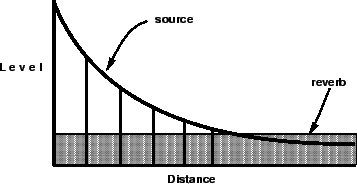
In visual perception, if one sees a larger object far and a smaller object near, their relation can be recognized from context. Aural perception includes analogous effects. The magnitude of a sound is source intensity, having a physical, objective value. But the perceived source level is loudness, a mental perception. If small source intensity is close to a listener, it is recognized as such through reverberation, which serves as the context as in visual perception. Since reverberation is the environmental context, it must be constant across distance, as suggested by Figure 3 depending only on source intensity [KMW90].
The following are equations for source and reverberation
as a function of distance and loudness in the PSFC,
using loudness and distance look-up tables,
created through psychoacoustic calibrations:

The
 is input to the PSFC to control
final source level, VOLUME.
is input to the PSFC to control
final source level, VOLUME.
 is the input to PSFC to control the
final reverb level, LIVENESS.
(Both
is the input to PSFC to control the
final reverb level, LIVENESS.
(Both
 and
and
 are maxima in dB.)
The
are maxima in dB.)
The
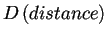 and
and
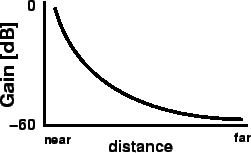
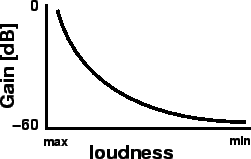
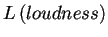 are look-up tables,
shown in Figure 4.
The
depends on the distance,
so the adjustment must include both distance and loudness.
Note that
does not depend on the distance.
are look-up tables,
shown in Figure 4.
The
depends on the distance,
so the adjustment must include both distance and loudness.
Note that
does not depend on the distance.