During the design of a helical keyboard [Herder-Cohen96], we
became aware that
global control of the mapping between visual space and acoustical
space could improve the intended experience. A major part in the design was the
soundscape. All keys had to be differentiable by location, especially
direction.
If the
listener is placed in the center, then keys playing in the far upper
part or lower part could not be well differentiated by azimuth, and also
the volume for them was too low. As a solution to these problems we
developed the
soundscape deformer,
a 3d widget that controls the
scene space  soundscape mapping
 . The scene space can be
shifted around, which induces a translation of the soundscape. In that
regard the soundscape deformer can be seen as a generalization of
stereo panning for 3D (e.g., balance potentiometer of an
amplifier, also known as a pan [for panoramic] pot).
. The scene space can be
shifted around, which induces a translation of the soundscape. In that
regard the soundscape deformer can be seen as a generalization of
stereo panning for 3D (e.g., balance potentiometer of an
amplifier, also known as a pan [for panoramic] pot).
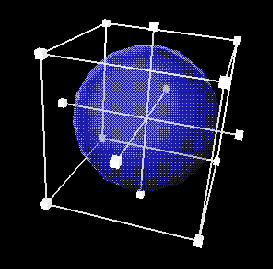
The soundscape deformer,
shown in Figure 1,
provides a visual representation of a linear mapping. A sphere in the center
represents the case in which the scene space is directly mapped to the
soundscape. The soundscape is fully interactively manipulatable via
handles (the small boxes on the outside), bounding box, and
orientation axes through a pointing device. Figure 2 shows the
soundscape reduced in height,
flattening the spatial audio position of all sound objects to a plane.
Another example,
shown in Figure 3,
reduces the horizontal dimension,
compressing the left  right attribute.
As an extreme example,
shown in Figure 4,
the sphere can be reduced to a point,
giving a diotic soundscape,
in which all objects seem to be at one place
inside the user's head.
right attribute.
As an extreme example,
shown in Figure 4,
the sphere can be reduced to a point,
giving a diotic soundscape,
in which all objects seem to be at one place
inside the user's head.
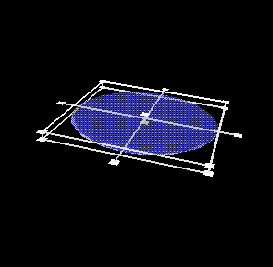
Figure 2: Soundscape deformer: flattening
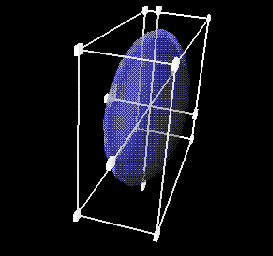
Figure 3: Soundscape deformer: narrowing

Figure 4: Soundscape deformer: extreme diotic case